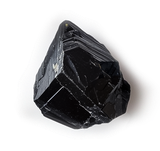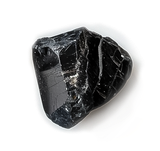
Black tourmaline is a stone that shows up in many places, from crystal shops and jewelry collections to home décor and personal accessories. At first glance, it doesn’t stand out for brilliance or color variation, but its deep black tone and solid presence tend to leave a strong impression. Over time, it has gained attention not because of how it sparkles, but because of the meaning people attach to it and the way it’s used in everyday life.
Black tourmaline is a naturally occurring mineral recognized for its deep black color and striated, slightly textured surface. It belongs to the tourmaline family, a group of boron silicate minerals that form deep within the Earth under high heat and pressure. The stone’s characteristic dark shade comes from its iron content, which also makes it heavier and more solid compared to many other gemstones.
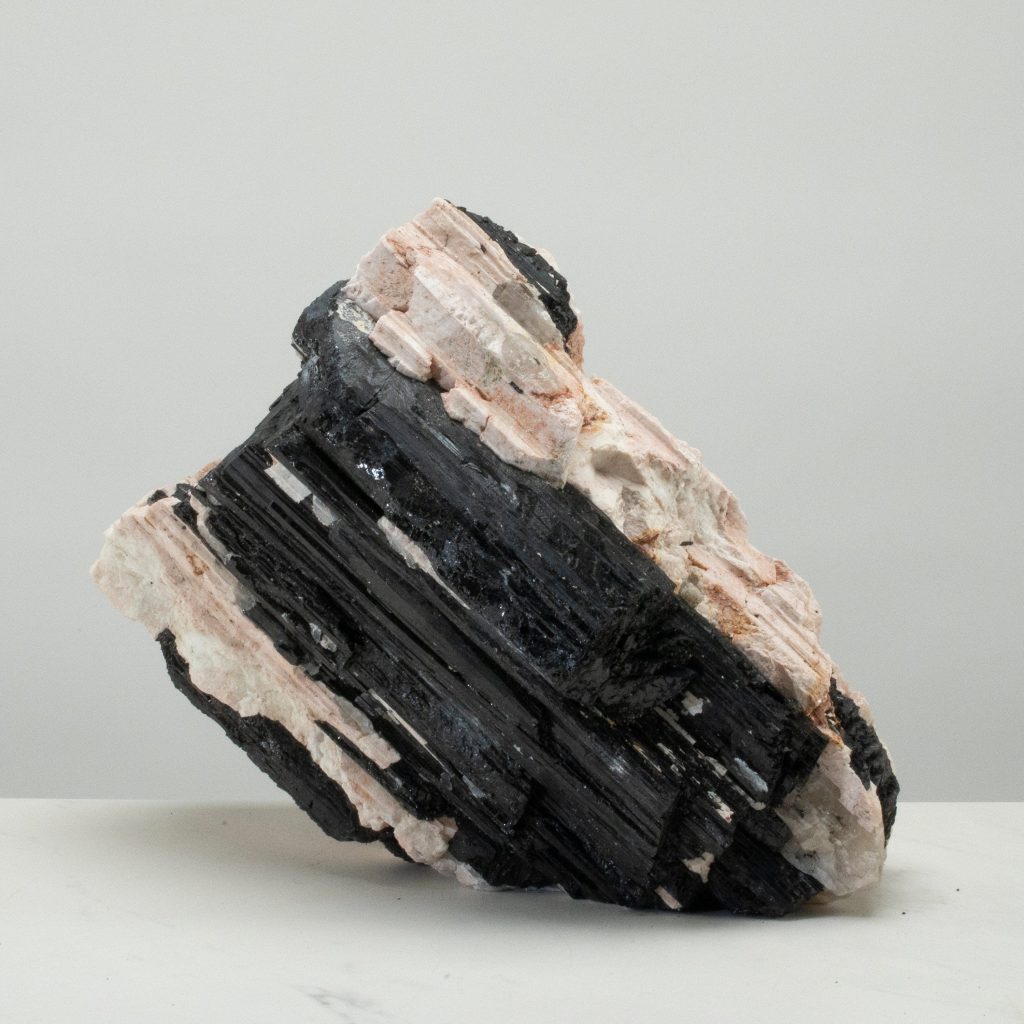
Unlike gemstones prized mainly for sparkle or transparency, black tourmaline is often appreciated in its raw or lightly polished form. You’ll frequently see it as rough crystal points, tumbled stones, or simple jewelry pieces that highlight its natural texture rather than refined perfection. This natural, unpolished appearance is part of what gives black tourmaline its distinct charm.
Black tourmaline forms deep within the Earth’s crust, often in regions where volcanic activity and high temperatures create the right conditions for mineral growth. It develops in igneous and metamorphic rocks, typically appearing as long, slender crystals with natural striations along their length.
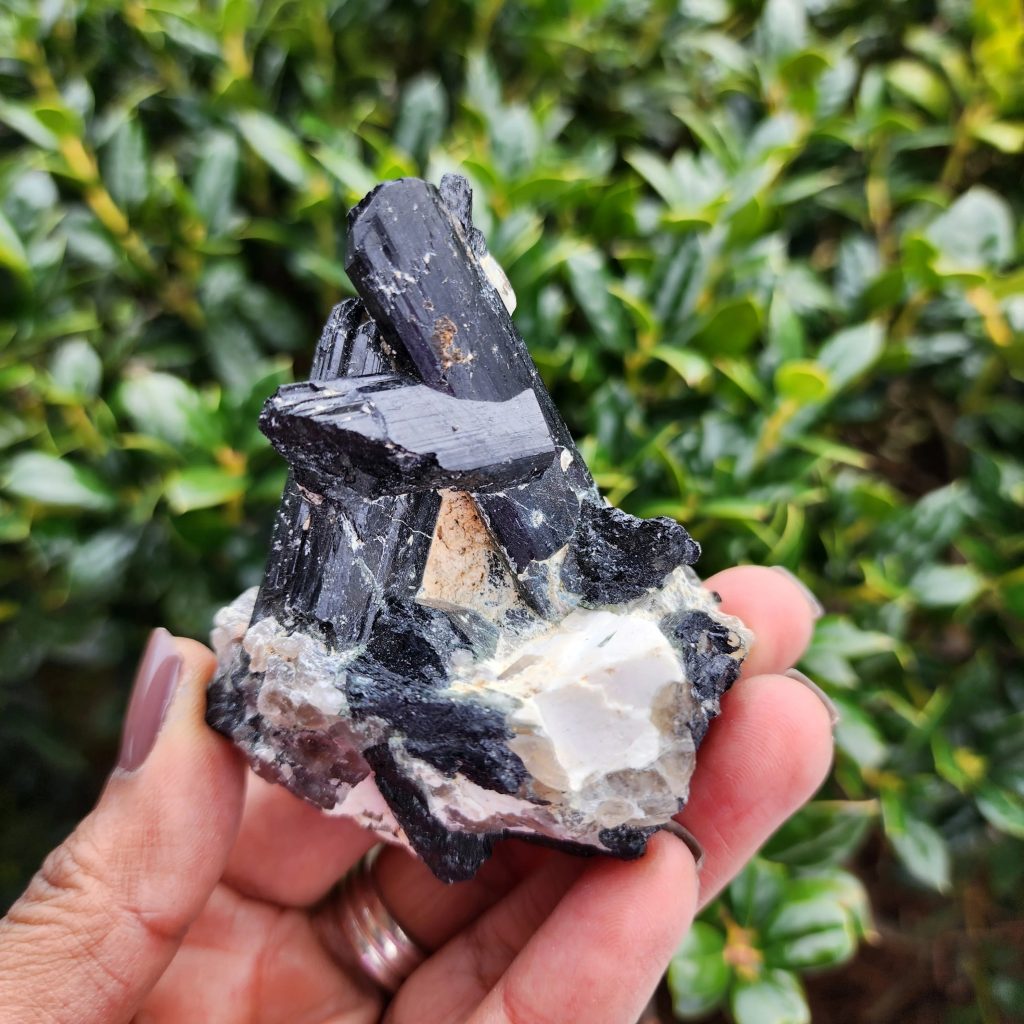
The process begins when boron-rich fluids interact with other minerals under intense heat and pressure. Over thousands or even millions of years, these elements gradually combine to create the dense, iron-rich black tourmaline crystals we see today. Its rugged surface and heavy feel are a direct result of this slow, natural formation, which makes each piece slightly unique in shape and texture.
Black tourmaline is not only visually striking but also physically robust, which makes it suitable for jewelry and decorative items. Its hardness and density are key factors that help gemologists and collectors identify it. Here’s a quick overview of its main physical properties:
| Property | Details |
|---|---|
| Chemical Formula | (Na,Ca)(Al,Fe,Li,Mg,Mn)₃Al₆(BO₃)₃Si₆O₁₈(OH)₄ |
| Crystal System | Trigonal |
| Hardness (Mohs Scale) | 7 – 7.5 |
| Density | 3.0 – 3.2 g/cm³ |
| Cleavage | Poor/indistinct |
| Fracture | Uneven to conchoidal |
| Color | Black (iron-rich) |
| Luster | Vitreous to submetallic |
Thanks to its Mohs hardness of 7–7.5, black tourmaline is durable enough for rings, pendants, and everyday wear, though it’s still important to handle it with care to avoid scratches or chips along its natural fractures.
Black tourmaline is found in several regions around the world, often in areas with rich geological activity. Major sources include Brazil, which produces some of the largest and most well-formed crystals, as well as Africa—especially countries like Namibia and Mozambique—where it occurs in both gem-quality and rough forms. The United States also has notable deposits, particularly in California, Maine, and New York, where black tourmaline is often found in pegmatite rocks alongside other gemstones.
The stone typically forms in igneous and metamorphic environments, and its quality can vary depending on the local conditions. While raw crystals are common in many regions, highly polished or larger gem-quality specimens are rarer and usually sourced from Brazil or Africa. Knowing the origin of black tourmaline helps collectors and jewelers understand its characteristics, appearance, and overall value.
Black tourmaline is a versatile stone when it comes to jewelry. Its deep black color and natural texture make it suitable for both casual everyday pieces and more elegant designs. Whether left raw or polished, the stone adds a bold, grounding touch to rings, earrings, bracelets, and necklaces. Here’s a closer look at how black tourmaline appears in different types of jewelry:
Elevate your jewelry collection with the bold, architectural beauty of this natural Black Tourmaline ring. Featuring a sleek, emerald-cut genuine gemstone set in a high-polished minimalist band, this piece is the perfect marriage of modern “power dressing” and ancient earthly wisdom.
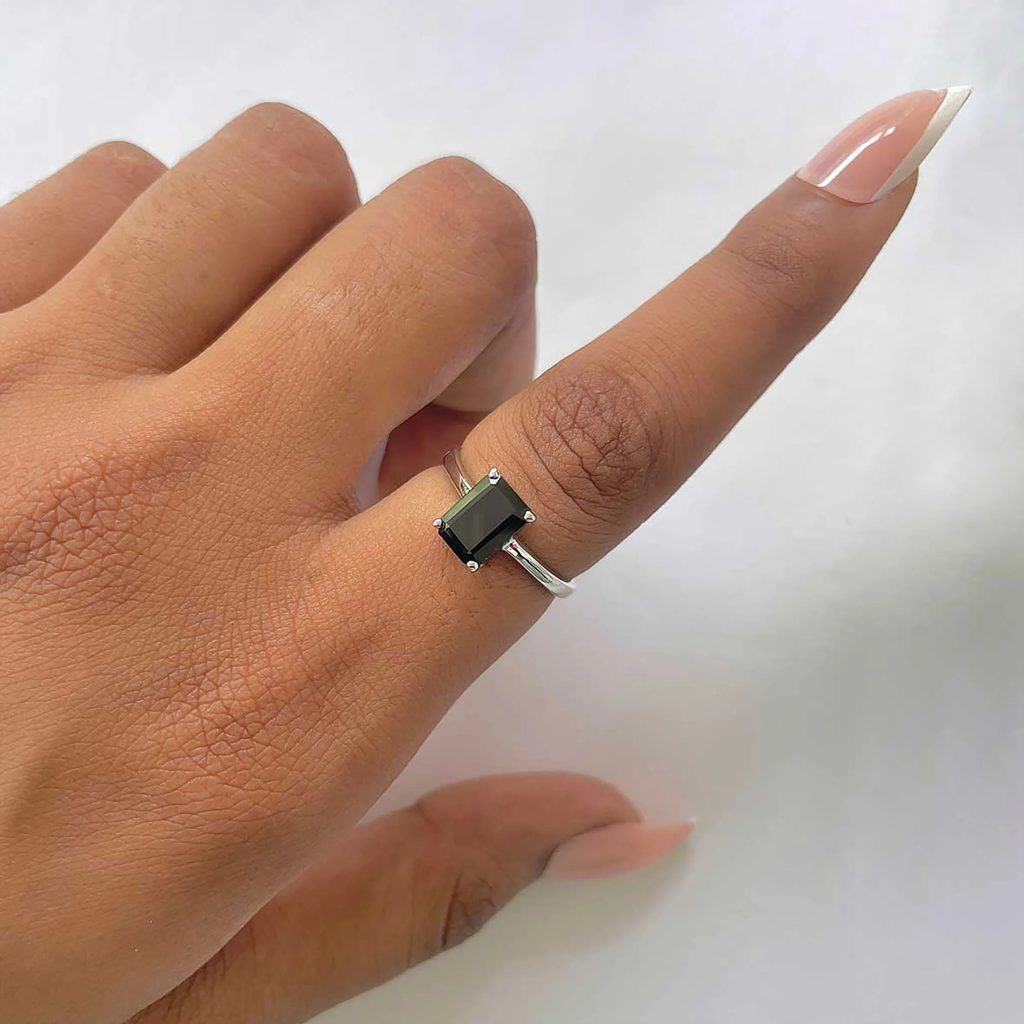
Known as the ultimate grounding stone, Black Tourmaline is more than just a stunning accessory; it is a personal talisman believed to provide a psychic shield against negative energy and EMF fog. Its deep, midnight-ink hue offers a sophisticated alternative to traditional black diamonds, making it an ideal alternative engagement ring or a meaningful daily companion for the modern soul.
This image features a person wearing a minimalist Black Tourmaline earring that showcases a striking contrast between natural textures and polished metal. The earring highlights a raw, uncut Black Tourmaline stone, preserving its organic, rugged form and deep matte black finish. This natural gemstone is securely held by a four-prong silver setting, where the bright metallic claws provide a clean, modern accent against the dark mineral. Positioned elegantly on the earlobe, the piece balances a rustic, earthy aesthetic with a refined jewelry design, making it a versatile accessory that emphasizes the unique, individual beauty of unrefined gemstones.

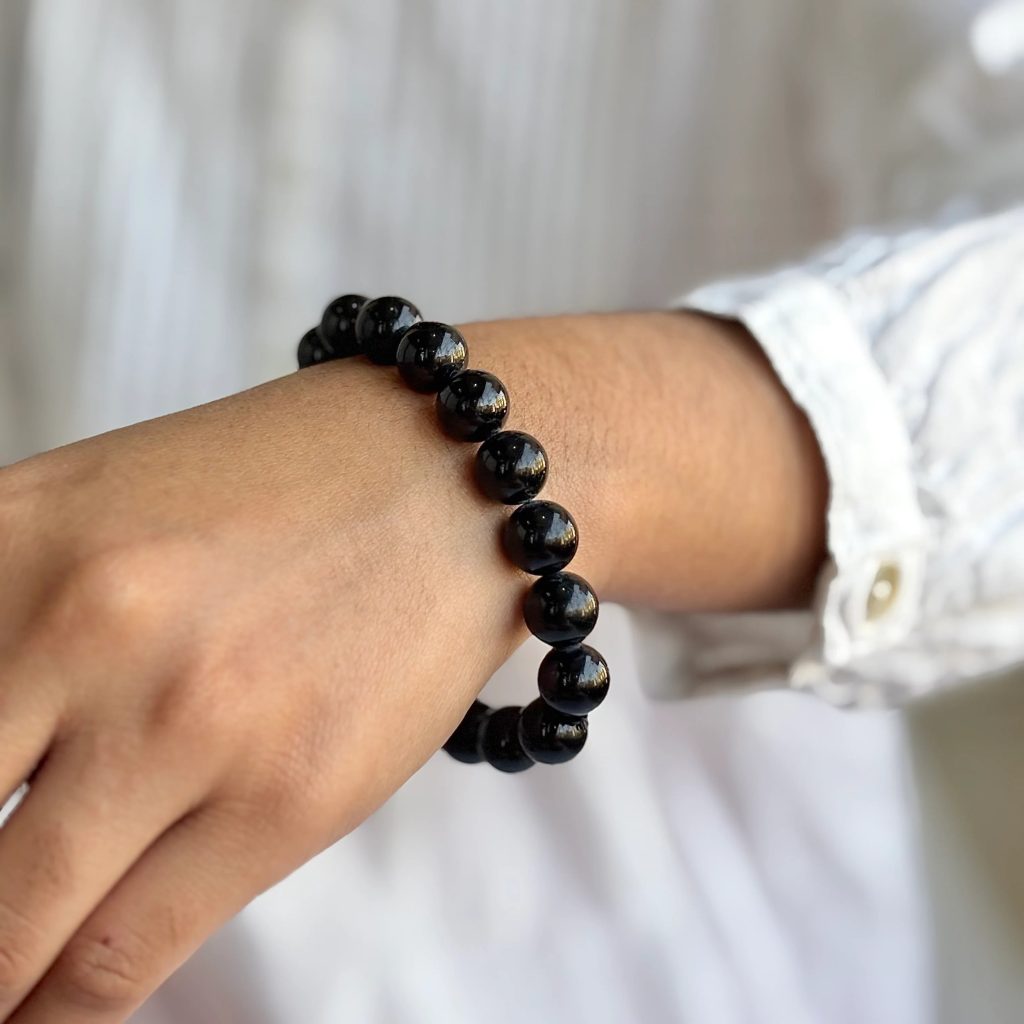
Bracelets often feature black tourmaline as beads, polished or matte, strung together for a natural, earthy look. They can also be combined with other gemstones for contrast or set into metal cuffs for a bolder style. Adjustable or stretch designs make these bracelets easy to wear and layer with other accessories.
Necklaces showcase black tourmaline either as a central pendant or as part of a beaded strand. Raw crystal pendants create a statement piece, while tumbled stones are used in more subtle, everyday designs. The stone’s dark color complements gold or silver chains, making it a versatile accessory for casual or elegant outfits.

Black tourmaline has a long history of symbolic meaning that stretches across cultures and centuries. Known in mineralogy as “schorl,” it was one of the earliest forms of tourmaline recognized by European miners in the Middle Ages, and its use as a protective talisman goes back much further. In many traditions, it was carried or worn to guard against harm and to provide a sense of safety and strength.
In modern usage, the meaning of black tourmaline often centers on grounding and protection. Practitioners of crystal lore associate it with the Earth element and the root chakra, linking it to feelings of stability, security, and being “anchored” in the present moment. This association with grounding reflects centuries-old beliefs that dark stones can help dispel fear and anxiety by connecting a person more strongly to the physical world.
Across both historical and contemporary contexts, black tourmaline carries a few consistent themes:
While these interpretations stem from cultural, historical, and metaphysical traditions rather than scientific study, they form the backbone of how black tourmaline is understood and used in jewelry, meditation, and personal practice today.
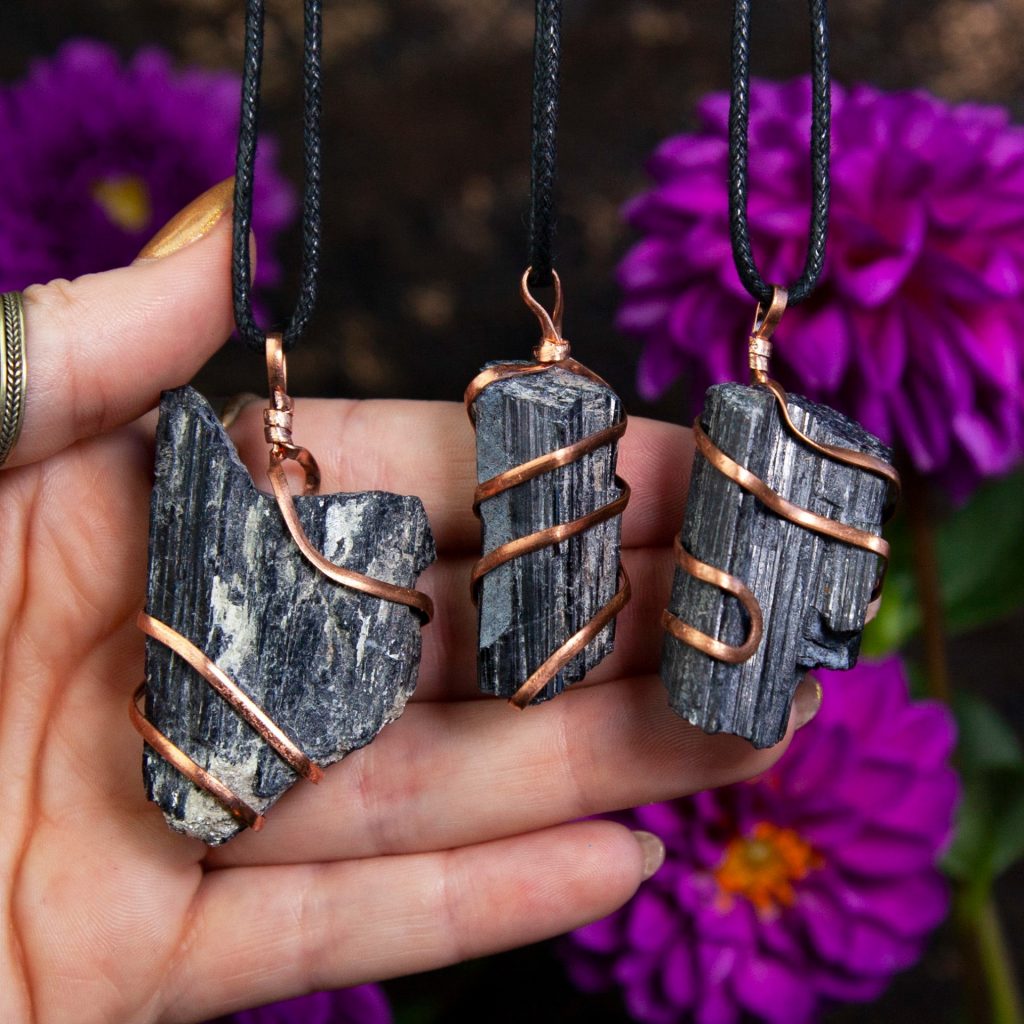
Black Tourmaline is unique due to its natural vertical striations and its physical properties. Unlike Obsidian (which is volcanic glass and softer) or Black Onyx (which is smooth and uniform), Black Tourmaline has a rugged, “raw” energy even when polished. Scientifically, it is pyroelectric and piezoelectric, meaning it can generate an electrical charge when heated or put under pressure. This is why it is historically linked to “shielding” and clearing energy.
To maintain its deep luster, clean your jewelry with warm, soapy water and a soft brush. Avoid using ultrasonic cleaners or steam cleaners, as the stone’s natural fractures and striations can be sensitive to intense vibrations or heat. When not in wear, store it in a separate pouch to prevent it from scratching softer gemstones or being scratched by harder ones like diamonds.
Yes, Black Tourmaline has a Mohs hardness of 7 to 7.5, making it quite durable for daily accessories like rings and bracelets. However, because of its natural crystalline structure, it can be prone to chipping if it takes a hard hit against a solid surface. It is a perfect choice for “power dressing” and daily talismans, provided it is handled with reasonable care.